


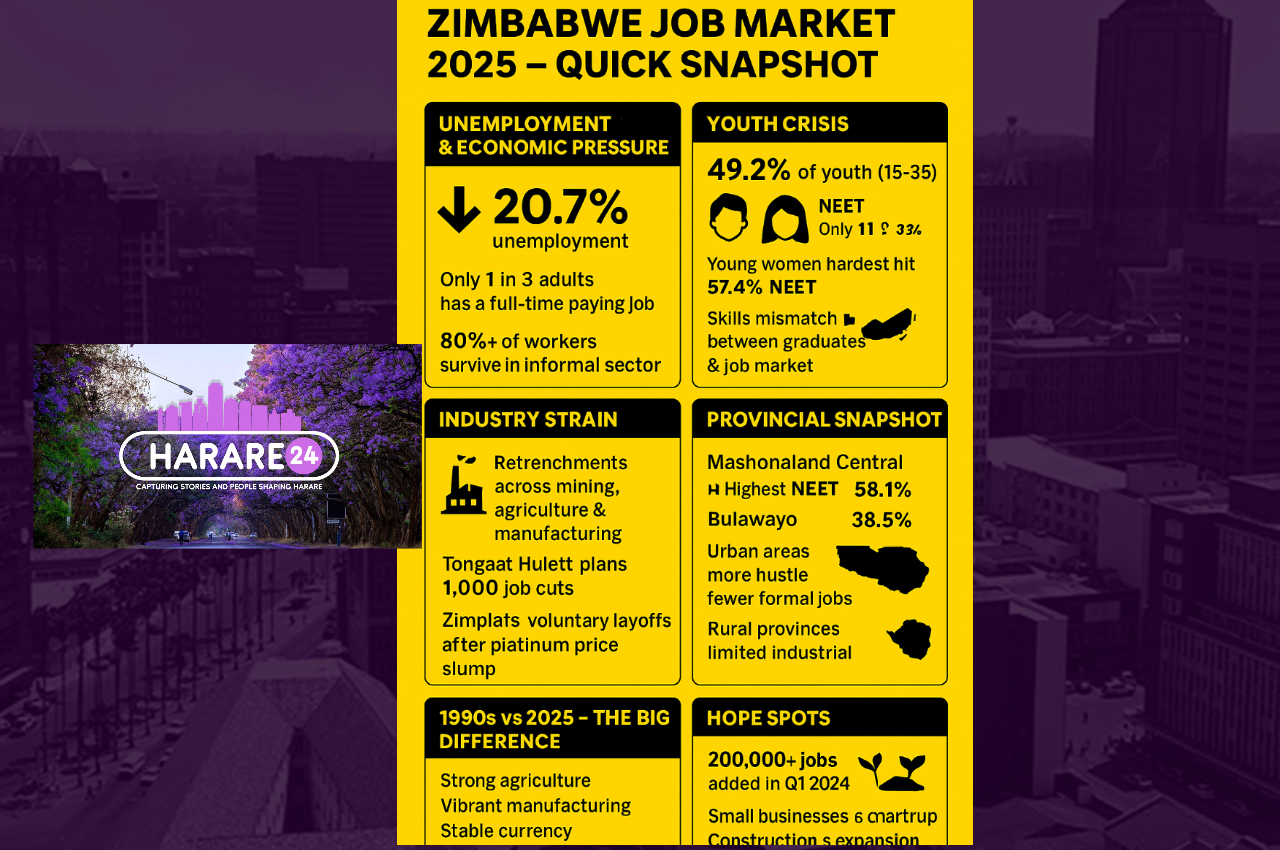
Zimbabwe’s job market in 2025 is under severe strain, with unemployment, informality, and youth idleness reaching levels that stand in stark contrast to the country’s economic heyday of the early to mid-1990s. New labour data and economic reports paint a picture of a labour landscape struggling to recover, raising urgent questions about the country’s long-term economic direction.
According to the latest 2025 labour surveys, joblessness in Zimbabwe remains deeply entrenched. TheGlobalEconomy reports that the national unemployment rate stood at 20.7 percent in the second quarter of 2025, while ZimStat’s recent labour force findings show an even more alarming trend among young people. Nearly 49.2 percent of Zimbabweans aged 15 to 35 are classified as NEET not in education, employment, or training a figure development experts warn could undermine the country’s future workforce. Young women bear the brunt of this crisis, with NEET rates above 57 percent, highlighting deep gender inequalities.
This fragile job market is also marked by extreme informality. The Afrobarometer 2025 survey revealed that only about a third of adults in the country hold a full-time job that pays a cash income. Most Zimbabweans who are considered “employed” operate in the informal sector, where incomes are unstable and job protections are non-existent. Economists say this informality suppresses productivity, weakens national tax revenue, and makes long-term economic planning nearly impossible.
Industry-wide retrenchments and closures continue to worsen the situation. Major companies in mining, manufacturing, and agriculture have laid off workers due to currency instability, rising operational costs, and declining global commodity prices. In 2025, sugar producer Tongaat Hulett announced plans to lay off 1,000 employees, while platinum giant Zimplats introduced voluntary job cuts after a slump in international platinum markets. These losses have sent shockwaves through communities already grappling with high living costs and limited alternatives.
A Sharp Contrast to Zimbabwe’s Golden Economic Era
The current employment environment stands in stark contrast to Zimbabwe’s most stable economic period the early and mid-1990s when the country was regarded as one of Africa’s most promising and diversified economies. During this period, Zimbabwe enjoyed:
- Strong agricultural output, especially in commercial farming, which absorbed labour and supported large agro-industries.
- A stable manufacturing sector, including textiles, steel, and food processing, which created thousands of formal jobs.
- A functioning currency and predictable inflation, providing businesses with stability needed to hire and expand.
- Robust growth in education and skilled labour, with thousands entering stable careers in health, administration, and engineering.
By contrast, 2025 Zimbabwe faces high operating costs, a volatile exchange rate, weakened industrial capacity, and an education system producing graduates who often cannot find work that matches their qualifications. Economists argue that while the 1990s were not without their challenges, Zimbabwe had functional institutions, stable policy frameworks, and productive industries capable of absorbing a fast-growing workforce conditions that have significantly deteriorated over the past two decades.
Regional Disparities Deepening
In 2025, employment prospects vary sharply by province. Mashonaland Central recorded the highest NEET rate at 58.1 percent, while Bulawayo had the lowest at 38.5 percent. Urban areas such as Harare and Bulawayo offer more informal trading opportunities, but fewer formal jobs, while rural provinces continue to struggle with limited industrial activity and youth migration.
Signs of Hope – But Still Not Enough
There have been flashes of improvement. In the first quarter of 2024, Zimbabwe added roughly 200,000 jobs, mostly in agriculture, construction, and small enterprises. But the majority of these new jobs were informal, temporary, or seasonal offering little long-term security. Development agencies warn that unless the country formalises more sectors, supports youth employability, and invests in industrial recovery, the job market will continue to stagnate.
The African Development Bank’s 2025 assessment emphasises that Zimbabwe’s greatest opportunity lies in its youth. Yet, without strategic reforms, the NEET crisis could erase the possibility of a demographic dividend an economic boost that nations gain when they effectively employ their young population.
A Country at a Crossroads
Zimbabwe’s job market in 2025 reflects a nation fighting to stabilise itself while carrying the weight of decades of economic decline. The contrast with the 1990s a time when Zimbabwe was often referred to as the “breadbasket of Africa” underscores how far the country has drifted from its most productive era.
Whether Zimbabwe can rebuild the conditions that once created stable jobs, strong industries, and economic confidence remains one of the biggest questions facing the nation today. As millions struggle to find secure work, the road back to the prosperity of the 1990s will require bold reforms, renewed trust in institutions, and sustained investment in the country’s youth.